 Fraunhofer Institute for Chemical Technology ICT
Investigation of an innovative anode concept for lithium- and sodium-ion batteries to increase energy density while maintaining cycle stability
The growing demand for sustainable, safe, and efficient energy storage systems, together with increasingly stringent requirements, can only be met by developing new materials. This project aims to investigate an innovative anode concept for lithium- and sodium-ion batteries, with the potential to significantly increase energy density compared with conventional anodes. The materials are selected and produced using raw materials that are abundant and widely available worldwide.
The key component is carbon with tailored internal porosity and chemical composition, designed to provide a stable framework for the reversible formation of metal clusters (lithium or sodium) during charging. The Fraunhofer–Max Planck Cooperation Programme provides an ideal platform for combining fundamental research into metal cluster formation in porous carbon with an evaluation of the technology’s application potential through its integration into prototype battery cells.
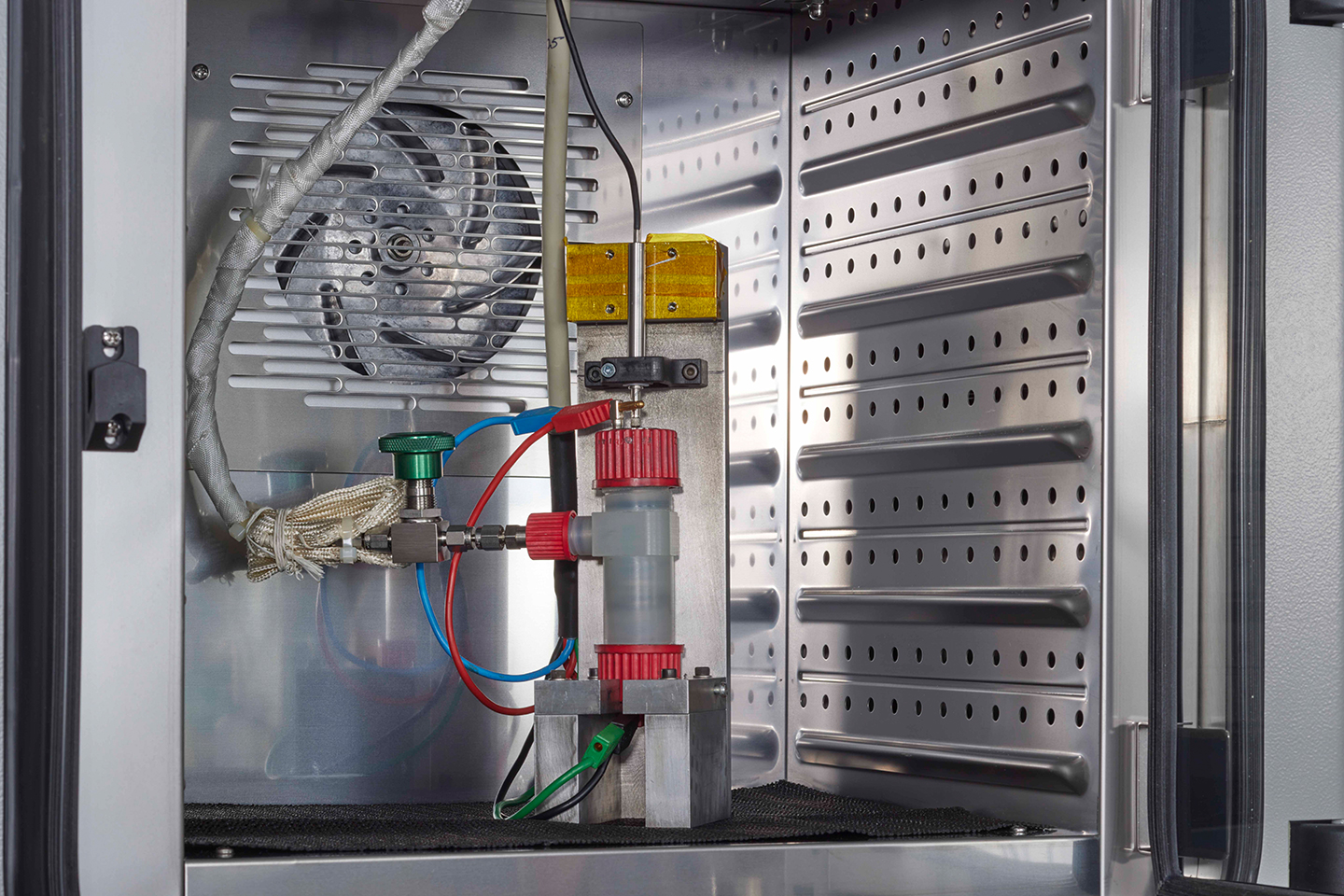
Fraunhofer ICT’s Batteries group contributes its expertise in measurement cell development, operando analytics, and aging studies.
Objectives of the ClusterBatt project
- Develop a fundamental understanding of metal cluster formation in porous carbon
- Design, synthesize, and characterize new carbon materials, and scale up and modify them
- Evaluate the concept in sodium- and lithium-ion battery cells under application-oriented conditions
Fraunhofer ICT’s tasks
- Conduct application-oriented operando analysis of lithium- and sodium-ion systems
- Investigate gas-phase composition and dimensional changes during charge and discharge
- Develop multifunctional measurement cells to simultaneously monitor the aging phenomena of gas generation and dimensional change
- Develop operando methods combining mass spectrometry and dilatometry for advanced characterization of battery active materials